Ice Maker Repair
Why Sub-Zero Ice Tastes Bad: Old Cubes, Filters and Dirty Bins
Fridge ice that tastes bad usually means stale cubes absorbing odors, an expired water filter or a dirty bin. Dump the ice, check the filter, wash the bin.
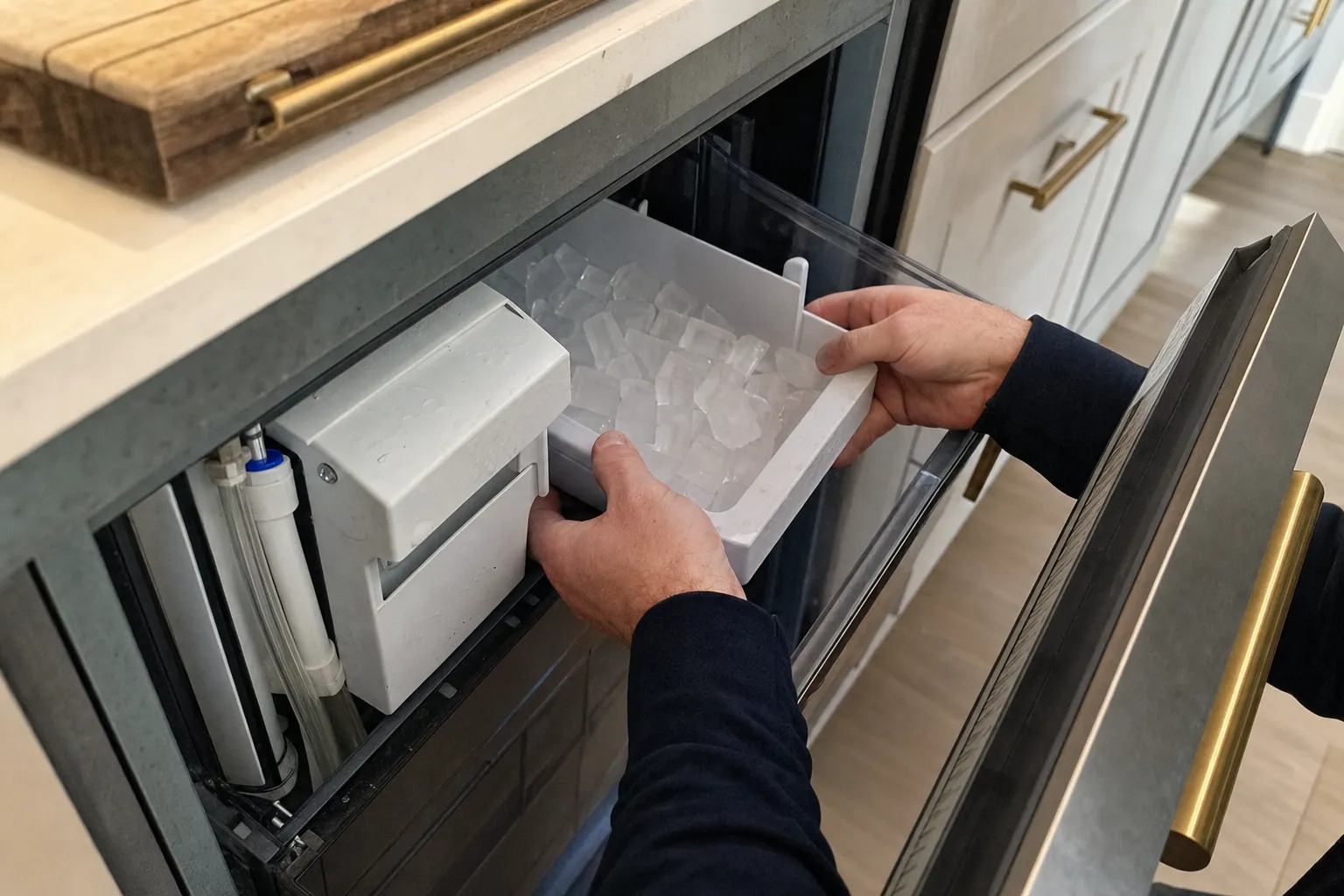
Bad-tasting ice almost always traces back to one of three things: cubes that sat in the bin long enough to absorb freezer smells, a water filter running past its rated life (or the wrong cartridge in the housing), or a bin and ice maker that need a proper cleaning. Start by dumping every cube, sealing anything pungent in the freezer, and finding out when the filter was last changed. If you own a Classic (CL) or a Designer (DET, DEC) model, twelve months or 750 gallons of use, whichever comes sooner, is the most Sub-Zero expects from one cartridge. Most Issaquah owners sort this out without a technician; checking things in the right order just saves you from buying filters you did not need.
Work out whether it is the water or the freezer
A three-glass comparison points you in the right direction. Fill one glass from the dispenser if your model has one, fill another from the kitchen tap, and let a handful of cubes melt in a clean third glass. Let all three warm to room temperature before tasting, because cold numbs the tongue and hides off flavors.
| What you notice | Where it usually starts |
|---|---|
| Melted ice tastes off, dispenser water is fine | Freezer odors or old cubes in the bin |
| Dispenser water and ice both taste off, tap is fine | Overdue, wrong or unflushed filter |
| Tap, dispenser and ice share the same odd taste | The household water itself |
| Musty or earthy note, cloudy or flaky cubes | Dirty bin or a scaled ice maker |
If the tap is the culprit, no refrigerator part will cure it. That becomes a question about the house plumbing or water treatment, not the appliance.
When the freezer is the source
Ice behaves like a sponge for odors. Cubes left untouched for weeks slowly take on whatever the freezer air carries, from fish and onions to the cardboard of a frozen pizza box, and as they age they shrink and frost over at the edges, which makes the stale note stronger. In a household that uses little ice, empty the bin every so often and let the maker refill it instead of letting the oldest cubes collect at the bottom.
Wrap or box anything strong, wipe up drips, then lift the bin out and give it a gentle wash in a sink of lukewarm, lightly soapy water. Rinse until no suds remain, because soap residue tastes worse than the original problem, and let it dry fully before it goes back. Sub-Zero built-ins with dual refrigeration keep the fresh-food air apart from the freezer air, so a smelly refrigerator shelf is rarely to blame for flavored ice; look inside the freezer first.
The water filter: timing, the right part and the flush
On models that carry one, the filter is the usual suspect when ice and dispenser water both taste flat, musty or faintly of chlorine. The cartridge in a Classic (CL), DET or DEC refrigerator has a life of twelve months or 750 gallons (2,839 L); swap it early if the indicator lights, pressure at the dispenser weakens, or the cubes come out hollow in the middle. The cartridge is tested by NSF International against NSF/ANSI 42, the standard for taste and odor, and NSF/ANSI 53, which covers health-related contaminants.
Fitting the correct cartridge matters as much as the date on it, so check the number before you order. Part 4204490 is the twist-in style, and 9030868 is an equivalent; between them they cover the PRO3650, PRO4850 and 648PRO, Designer units such as DET and DEC, and Classic refrigerators badged BI or CL. Some older BI refrigerators use a two-prong push-in cartridge rather than the twist-in kind. If your notes say 7023811, the microbiological one, you will not find it any more: 7045454 took its place, and it is designed to treat color, taste and odor. A look-alike that seats loosely can let water slip around the media, which tastes no better than having no filter at all.
Then comes the step most people skip. A new cartridge releases loose carbon fines and air for a short time, so Sub-Zero tells owners of non-dispenser Classic and Designer models to throw out the first two full bins of ice, while dispenser models should run water for two minutes. Skip it and the new filter seems to have made things worse. Our water filter change routine walks through the whole sequence.
If your model has no internal filter
Plenty of Sub-Zero units have no filter inside at all: wine storage other than the IW-30CI, the UC-24 undercounter, DEU undercounter refrigeration, ID drawer models and several of the built-in series. The DEU1550I ice maker also ships without one. On those, any filtering happens under the sink or in a line cartridge added at installation, and that is the one to check and replace.
Undercounter ice makers keep their own calendar
A standalone ice maker turns over far more water than a freezer tray does, so it builds scale and film faster. The UC-15I uses filter 7042803 (formerly 7012333), due every six months, after a long shutdown, or whenever the red REPLACE FILTER light appears, which it does after 8000 ice-making cycles. With the fresh cartridge installed, press CLEAN and keep your finger there for 6 seconds so the indicator resets, and do not keep the first batch the machine produces.
Cleaning affects taste just as much. Every six months the UC-15I needs two cycles. For the first, start CLEAN and clear out the bin; when the light begins to flash, the machine wants 4 ounces (115 ml) of cleaner. The second cycle runs the same way, only with 1 tablespoon (15 ml) of sanitizer. Each pass takes about 30 minutes and cannot be canceled once started, so choose a time when you can let it finish. The UC-15I and DEU1550I share the same cleaner and sanitizer, but those are not interchangeable with the 315I solutions. For the Designer Series undercounter model, the first clean happens when it is set up; after that, softer water lets you stretch to six months, while harder water argues for three.
Reverse osmosis, new lines and an empty house
Households that add reverse osmosis to fix taste sometimes end up with ice that tastes flat, simply because the minerals that give water its character have been stripped out. Sub-Zero says an RO system can supply its refrigerators provided the pressure holds steady between 35 and 120 psi, but any internal push-in or twist-in filter should then be bypassed, and the tubing after the RO unit should not be copper; purified water tends to pull a metallic taste from it.
A brand-new supply line can give off a plastic note for the first few days, and a house that sits empty for a few weeks leaves water standing in the line and the cartridge. In either case, run water through the dispenser and dump the first bins of ice before judging the result. That holds whether the kitchen is in one of the older houses around Olde Town or a newer home up in Talus or the Issaquah Highlands.
When bad taste points to a fault
Sometimes the flavor is the first sign of a mechanical problem. Hollow or undersized cubes, a bin that fills slowly, or water pooling beneath the ice maker can mean low pressure, a partly blocked fill valve or a kinked supply line. Supply pressure matters too: one group of models needs 20 to 100 psi and another 35 to 120 psi, and since there is no built-in gauge, a plumber should take the reading. If the filter is fresh, the bin is clean and the taste lingers alongside those symptoms, it is time for a diagnosis.
Our visit fee is $89; it gets a technician to your kitchen to pin down the fault, and we subtract it from the repair if you approve one. Replacing an ice maker, water valve or supply line typically falls between $290–$750, with the firm quote given after diagnosis. Details are on our Sub-Zero ice maker repair page, or call (425) 272-6613.
Common follow-ups
Can a new water filter make ice taste worse?
Yes, for a short while. A fresh cartridge sheds fine carbon dust and holds trapped air, so Sub-Zero's advice for non-dispenser Classic (CL) and Designer (DET, DEC) models is to discard two complete bins of new ice; on a dispenser model, two minutes of running water does the same job. If the odd taste outlasts that flush, confirm the part number and that the filter is fully seated.
Why does my Sub-Zero ice taste off when the model has no filter?
Because nothing inside the unit is cleaning the water on its way to the ice maker. No internal filter is fitted to ID drawers, the UC-24, DEU undercounter refrigeration, several built-in lines or any wine storage unit except the IW-30CI, so the answer lies in the house water, an under-sink or inline cartridge, or the freezer itself.
How often should an undercounter ice maker be cleaned?
The UC-15I should be cleaned and sanitized every six months, with its condenser behind the kickplate cleaned on the same schedule. The Designer Series undercounter unit gets its first clean when it is installed, then a repeat somewhere between three and six months later, sooner with harder water; out of the box its reminder comes up at three months.
Is ice that tastes bad safe to use?
A stale or chlorine taste is normally a nuisance rather than a health problem, but it is still worth tracking down. If the ice or water smells of sewage, looks discolored or seems to make anyone unwell, stop using it, empty the bin and have the household water tested before changing parts.
How much should I budget if cleaning and a new filter do not fix the taste?
Start with the $89 service call, which buys the visit and a complete diagnosis and comes off the bill if you go ahead with the work. If the ice maker, water valve or supply line turns out to be at fault, that repair typically lands between $290–$750, with the firm figure given after diagnosis.