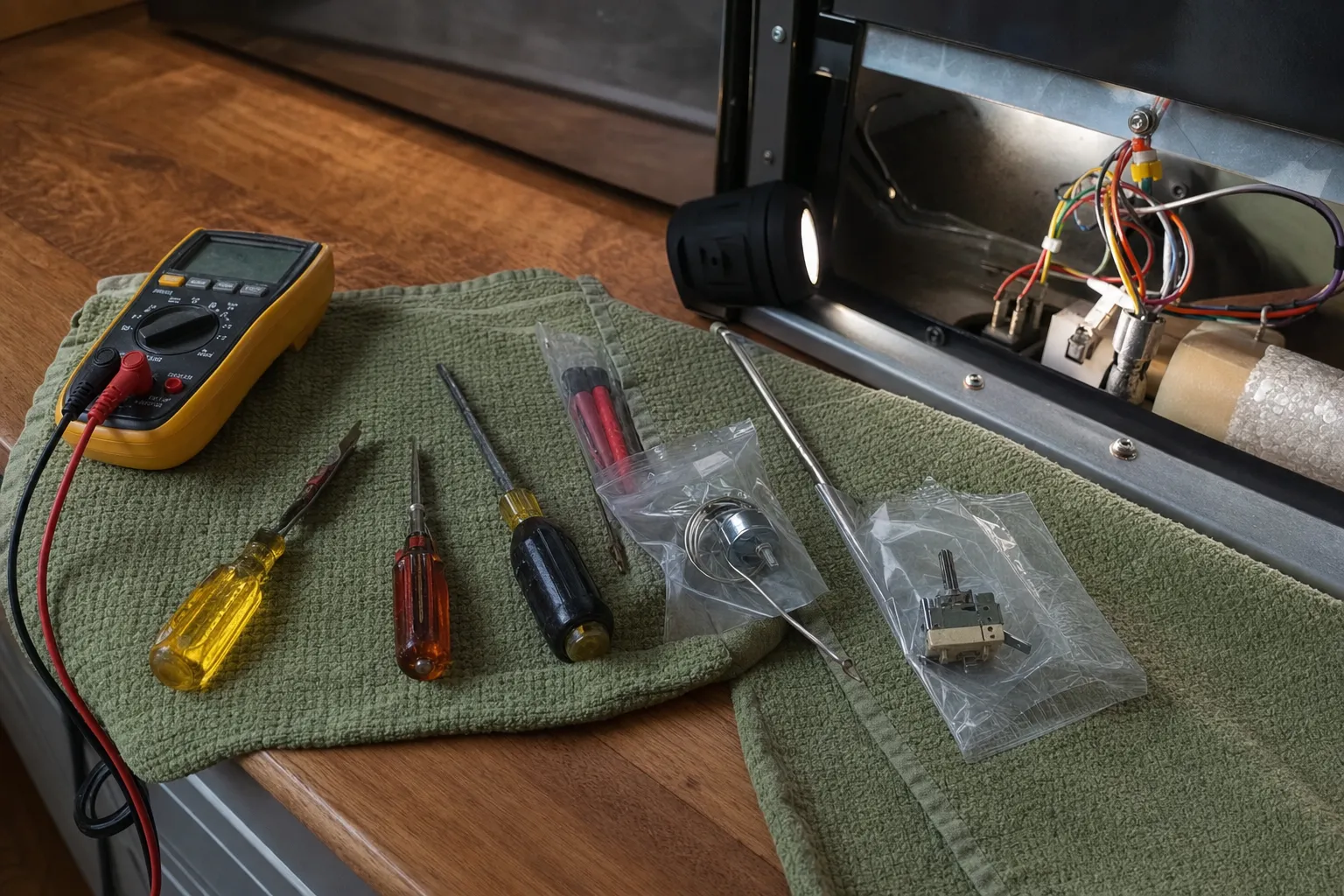
Wine Cooler Repair
Why a Sub-Zero Wine Cooler Drifts Out of Temperature
A zone that reads 55°F while the bottles sit at 62°F is rarely the compressor. What drift on a Sub-Zero wine unit means, and when it is a service call.
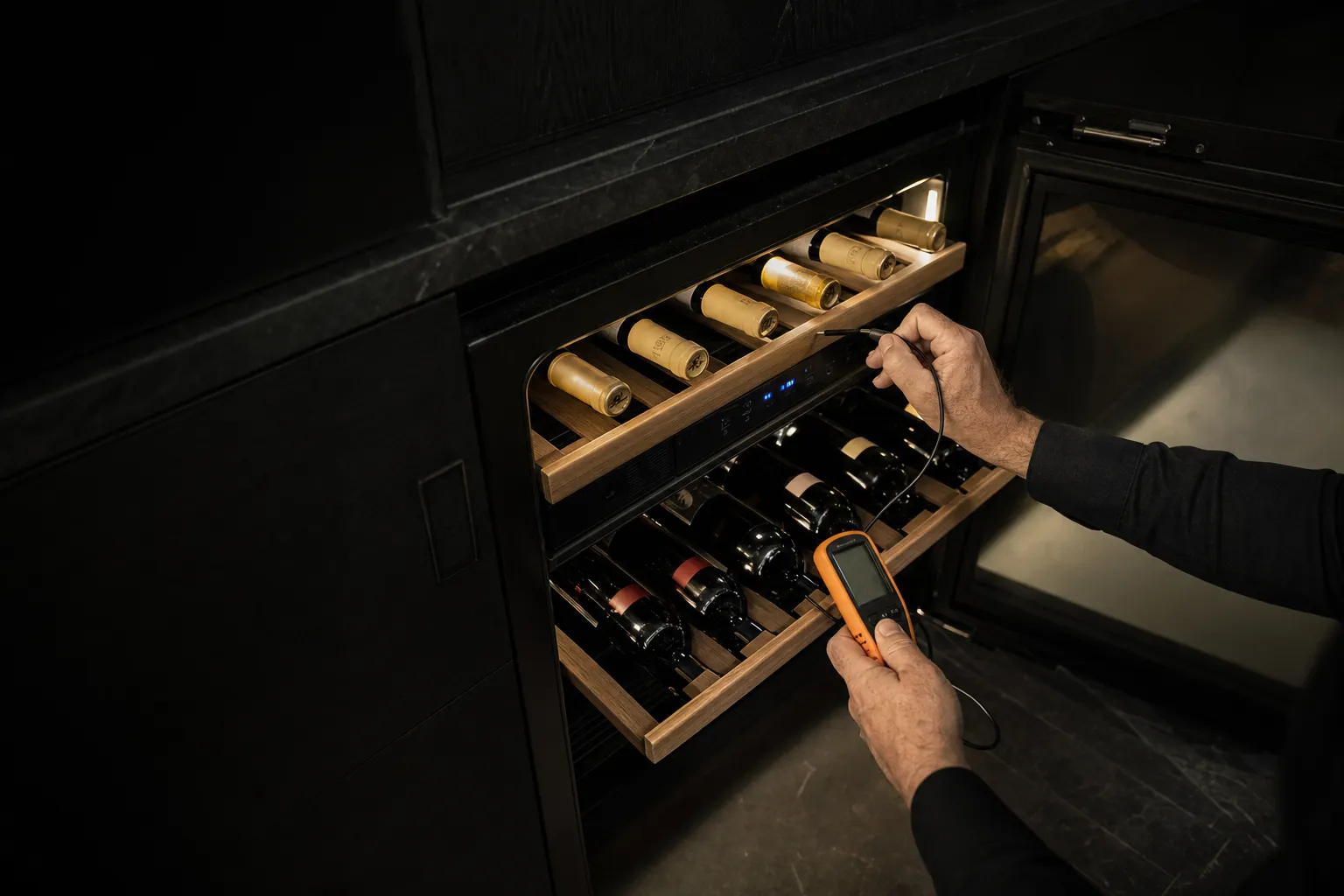
A wine cabinet is the one appliance in the house where a fault can go unnoticed for months. Nothing spoils overnight, nothing smells, no alarm sounds. The display keeps showing the number you set it to, and the only clue is a bottle that pours warmer than it should. By the time most people in Issaquah call about it, the unit has been drifting for a season.
Zone drift is also the fault most often misdiagnosed as “the compressor is going”. It usually is not.
What zone drift actually is
Drift means the temperature the cabinet is holding no longer matches the temperature it believes it is holding. There are only three places that gap can come from:
- the sensor — a thermistor reading a couple of degrees off, so the control is satisfied before the compartment actually is
- the air — a damper, fan or duct that is no longer sending the right amount of cold air into that zone
- the envelope — a door seal, hinge or gasket letting warm room air in faster than the system removes it
Only the third of those is visible without instruments, which is why the guesswork usually lands on the compressor by elimination. But a failing compressor on a wine unit does not present as a two-zone split. It presents as both zones climbing together, over days, with the unit running constantly and warm air off the condenser. If one zone is right and the other is not, the compressor is doing its job.
Confirming it before anyone comes out
You need one thing: a cheap probe thermometer, and the patience to leave it alone.
Put the probe in the middle of the affected zone, in a half-full bottle of water if you can — the water damps the swings and gives you the temperature the wine is actually experiencing rather than the air temperature at that moment. Leave it twenty-four hours, undisturbed, with the door kept shut.
Then compare. If the probe and the display agree, the cabinet is holding what it says it is and you have a setpoint conversation, not a repair. If the probe reads consistently warmer, note the gap in degrees and whether it is steady or wandering. A steady offset points at the sensor or the calibration. A wandering one points at airflow or the seal.
While you are there, do the paper test on the door. Close a sheet of paper in the gasket at four points down the seal and pull each one out. If any of them slides free with no drag, the gasket has lost its pull in that spot. On a glass door, look for condensation on the inside pane at the same height — the two symptoms travel together.
Then look down. An undercounter unit breathes through its kickplate at floor level, and a kickplate furred with dust makes every other reading harder to trust; the kickplate and airflow routine for undercounter units covers what to clear before the twenty-four hours start.
The Issaquah-specific bit: where these units live
Almost every wine unit we see in the Highlands or Talus is installed into cabinetry, and a good proportion sit in a butler’s pantry, an island run, or a lower-level bar area. Three things follow from that.
First, ventilation. A built-in wine unit has to shed its heat through louvres — on undercounter models, the kickplate at floor level. Refit the cabinetry, or swap a louvred kickboard for a solid one, and that air path chokes: the unit runs hot and long. It will hold temperature for a while, then stop holding it in summer.
Second, the lower-level bar problem. A room that is genuinely cool in February and warm in August will push a marginal unit over the edge seasonally. If your drift started in June, that is worth saying on the phone.
Third, the units in the Squak Mountain and Olde Town houses tend to be older installations — often the original appliance from a nineties or early-2000s remodel. Sensors and dampers on those have simply been in service a long time, and they are inexpensive parts.
What the repair usually turns out to be
In rough order of how often we find them:
- A thermistor reading off. An inexpensive part. The control is not lying to you on purpose; it is faithfully reporting a bad number. Replace and recalibrate.
- A damper motor that no longer opens fully. Common on dual-zone cabinets, because the damper is the only thing dividing one cooling system into two independent compartments. A partially open damper produces exactly the split people describe.
- A tired door gasket. Cheap, quick, and the one most likely to be the real cause when there is condensation involved.
- A blocked or dirty condenser. Especially in installations where the grille has been covered or the pantry collects dust. Cleaning it is maintenance, not repair.
- An evaporator fan on its way out. Usually audible before it is measurable — a change in the sound of the unit at night is a genuine diagnostic clue.
Sealed-system faults do occur, and they are the expensive end. But they are the last thing to check, not the first, and any shop that opens with that conclusion before putting gauges on the unit is guessing with your money.
When it stops being worth waiting
If the affected zone is holding within two or three degrees, and it is steady, you have time. Order the probe, do the twenty-four-hour test, look at the gasket.
Call sooner if any of these are true: the gap is more than five degrees, the temperature is swinging rather than sitting, there is condensation inside the glass, the unit is running continuously without cycling off, or the cabinet contains anything you would be genuinely upset to lose. Wine does not fail suddenly, but sustained warmth ages it irreversibly, and the parts that cause this are cheap relative to the contents of most cabinets we open.
Common follow-ups
How far out of range is actually a problem?
A steady two degrees either side of the setpoint is normal for a dual-zone unit and will not hurt anything. Five degrees or more, or a zone that swings back and forth across a ten-degree band, is worth investigating — it is the swing rather than the absolute number that ages a bottle.
Can I just set the display lower to compensate?
It masks the symptom and usually makes things worse. If the sensor is reading two degrees low, dialling the setpoint down two degrees makes the compressor run longer to hit a number that was already wrong, and the second zone drifts with it.
Does a wine unit need the same defrost cycle as a refrigerator?
It runs one, but far less aggressively, because the evaporator never goes far below freezing. That is exactly why a wine unit shows a failing defrost or airflow fault as slow drift rather than a wall of frost.